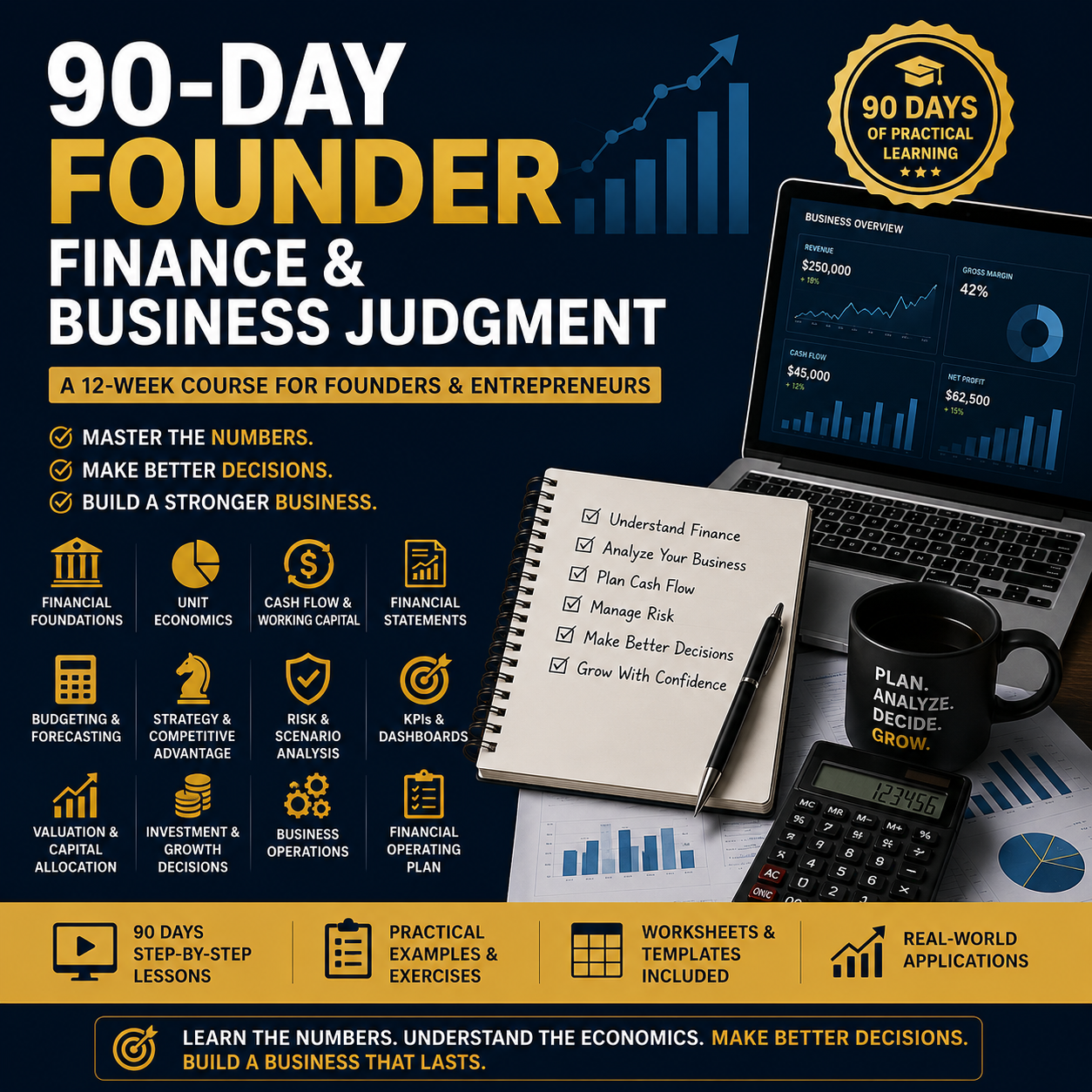
90-Day Founder Finance & Business Judgment

Categories: Finance & Business
Wishlist Share

About Course

Build the financial knowledge and business judgment you need to make better founder decisions.

The 90-Day Founder Finance & Business Judgment program takes you through a structured 90-day process covering financial foundations, business economics, risk, strategy, and decision-making.

You will work with real numbers, real business scenarios, and practical exercises rather than relying on theory alone.

What you will work on:

• Understand revenue, expenses, profit, and cash flow
• Build a clear financial baseline
• Learn how to evaluate pricing and margins
• Understand break-even and unit economics
• Evaluate business opportunities using numbers
• Understand risk, return, and opportunity cost
• Make better decisions about spending and reinvestment
• Learn how to evaluate hiring and outsourcing decisions
• Develop stronger financial and strategic judgment
• Build your own founder decision framework

The program is divided into three phases:

Phase 1: Financial Foundation
Days 1–30

Phase 2: Business Judgment
Days 31–60

Phase 3: Founder Decision-Making
Days 61–90

Each stage combines lessons, examples, exercises, quizzes, and practical founder decisions.

By the end of the program, you will have a clearer understanding of your numbers and a structured process for evaluating important business decisions.

Show More

Course Content

Week 1: Your Financial Baseline
Establish your current financial position. Understand your income, expenses, assets, liabilities, cash position, and personal versus business finances.

  • Day 1: Where You Stand
  • Day 2: Personal Money vs Business Money
  • Day 3: Understanding Your Income
  • Day 4: Understanding Your Expenses
  • Day 5: Assets and Liabilities
  • Day 6: Your Net Worth
  • Day 7: Build Your Financial Baseline
  • Week 1 Financial Baseline Quiz

Week 2: Revenue, Costs, and Profit
Week 2 focuses on understanding how money moves through a business. You will learn the difference between revenue, costs, and profit, how fixed and variable costs affect your business, and how to evaluate whether your business is actually making money. By the end of this week, you will understand how to read your basic profit numbers and identify which costs have the biggest effect on your business.

Week 3: Cash Flow and Working Capital
Week 3 focuses on understanding how cash moves through a business. You will learn why a profitable business can still run out of cash, how to track cash inflows and outflows, how receivables and payables affect cash, and how working capital affects your ability to operate and grow. By the end of this week, you will build a basic cash flow baseline for your business.

Week 4: Financial Statements and Business Health
Understand the three core financial statements and how they work together. You will learn how to read a balance sheet, income statement, and cash flow statement, identify the financial health of a business, and use financial statements to make better decisions. By the end of the week, you will know what the numbers are telling you and where to look when something goes wrong.

Week 5: Financial Ratios and Business Performance
Week 5 focuses on financial ratios that help you evaluate business performance. You will learn how to measure profitability, liquidity, debt, efficiency, and return on investment. You will also learn how to compare these numbers over time and use them to identify financial strengths, weaknesses, and areas that need attention.

Week 6: Pricing, Unit Economics, and Customer Profitability
Learn how pricing decisions affect revenue, margins, cash flow, and business growth. You will learn different pricing methods, calculate unit economics, understand customer acquisition cost and customer lifetime value, and evaluate whether individual products, services, and customers are financially worth pursuing.

Week 7: Financial Decision-Making and Business Strategy
Learn how to use financial information to make better business decisions. You will learn how to evaluate opportunities, compare costs and benefits, manage trade-offs, assess financial risk, and make decisions using data instead of intuition alone.

Week 8: Cash Flow Management and Financial Control
Learn how to manage the movement of cash through your business and maintain enough liquidity to operate safely. You will learn how cash flow differs from profit, how to forecast cash needs, manage receivables and payables, build a cash reserve, control expenses, and identify cash-flow problems before they become serious.

Week 9:Financial Statements and Business Performance
FINANCIAL STATEMENTS AND BUSINESS PERFORMANCE Week 9 teaches you how to read and use the three core financial statements to understand the financial health of a business. You will learn how to analyze: • Income Statement • Balance Sheet • Cash Flow Statement • Working Capital • Financial Ratios • Gross Margin • Operating Margin • Profitability • Liquidity • Debt • Financial Efficiency You will learn how revenue turns into profit, how assets and liabilities affect the business, and why a profitable business still needs strong cash flow and liquidity. You will also learn how to connect the three financial statements instead of looking at each one separately. By the end of Week 9, you should be able to answer: • Is the business profitable? • Is revenue growing? • Are margins improving? • Is the business generating enough cash? • Does the business have enough working capital? • Is debt becoming a problem? • Are assets being used efficiently? • Where is the business losing money? • Which financial metric needs attention first? Week 9 Goal Build the ability to read financial statements like a founder, identify financial problems early, and use financial data to make better business decisions.

Week 10: Business Valuation, Funding, and Capital Allocation
Week 10 focuses on how founders evaluate the value of a business, decide when to use debt or equity, and allocate limited capital to the opportunities with the best financial return.

Week 11: Business Strategy, Risk Management, and Growth Decisions
Week 11 focuses on using financial information to make better business decisions. You will move beyond the numbers and evaluate strategy, competition, risk, growth, and long-term business value.

Week 12: Financial Forecasting, Budgeting, and Cash Flow Planning
Week 12 focuses on turning your business strategy into numbers you can plan, monitor, and manage.

Student Ratings & Reviews

No Review Yet
No Review Yet